
Joomla Hosting BLOG

Blog about Joomla, Technologies and Hosting Service

Joomla Hosting - ASPHostPortal.com :: How to Resolve “Page Not Found” Errors on Joomla Sites

clock January 26, 2015 07:56 by author ben

When you advise Joomla to utilize SEF (static) Urls, a few clients may encounter 404 blunders ("page not found") when they click menu things on your site. On the off chance that the SEF Urls setting in Joomla breaks your menu things, making Urls that can't be discovered, regardless you have trust.

In case you're utilizing the Apache web server, you can utilize the mod_rewrite module to educate Joomla to modify Urls in SEF adaptations. Additionally, take a glance at a famous expansion called sh404sef. Considered by numerous to be one of the best SEF apparatuses accessible, sh404sef is both JED Editor's pick and in addition a settled download most loved among genuine Joomla clients.

You just need to stress over undertaking the accompanying steps if the SEF URL choice in the Global Configuration page breaks the Urls on your site. In the event that the SEO Friendly Urls alternative is situated to Yes in the Global Configuration page SEO sheet and you discover your Joomla site is working as it ought to, there's no compelling reason to dive into this.

Check for mod_rewrite

To begin with, figure out whether your Apache establishment incorporates mod_rewrite. Restricted is to check with the tech staff of your Internet facilitating supplier, yet in the event that your facilitating supplier's tech staff is anything like mine, they won't have a sign. You can check for the module yourself, in any case.

On the off chance that end up hitting a block divider each time you set out for some searching for technical support, consider searching for a more Joomla-accommodating facilitating organization. Nowadays, there are a considerable measure of them out there, and they would most likely be excited to have your business.

On the off chance that mod_rewrite is being stacked, you can see that in Joomla. Click on the Site catch, found in the upper left-hand corner of any back-end page. Starting from the drop menu, select System Information. After the System Information page burdens, select the PHP data tab. The complete whole of your Joomla site's PHP data is presently readily available.

Design Joomla to utilize mod_rewrite

At the point when mod_rewrite is accessible, you can design Joomla to utilize it by renaming a record in Joomla's root registry. Take after these steps:

  • Look in the registry where you introduced Joomla for a record named htaccess.txt.
  • Rename this document .htaccess.
  • Restart Apache.
  • At the point when Apache restarts, your new .htaccess document produces results.
  • Pick Site →global Configuration in any back-end page to open the Global Configuration page.
  • In the SEO Settings sheet, select the Yes radio catch in the Use Apache mod_rewrite segment.

Congrats! SEF Urls ought to work for you now
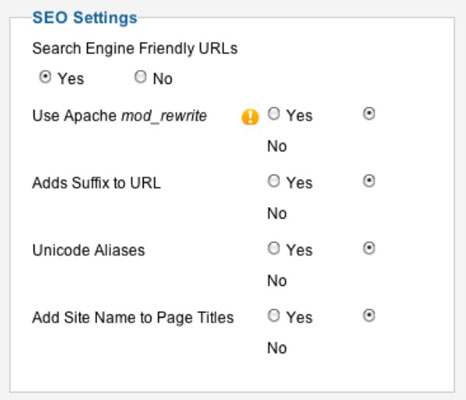
TIPS : Numerous hosts don't oblige you to restart Apache in the wake of rolling out improvements to your .htaccess document. Then again, a few hosts might as of now have a .htaccess record which Joomla needs to be added to. On the off chance that you experience any troubles in arranging your site to utilize mod_rewrite, check in with your facilitating supplier's technical support for aid.

NOTES : SEF settings are all that much indigent upon how your facilitating supplier is situated up. Tragically, not all SEF settings chip away at all facilitating suppliers. On the off chance that you have issues with your SEF settings, you will need to weigh in with your facilitating supplier's help administrations for aid. As dependably, you can likewise depend upon the a huge number of clients at the Joomla.org help gatherings to furnish you with tips to get you up and running.

Best Joomla Hosting Recommendation

ASPHostPortal.com provides our customers with Plesk Panel, one of the most popular and stable control panels for Windows hosting, as free. You could also see the latest .NET framework, a crazy amount of functionality as well as Large disk space, bandwidth, MSSQL databases and more. All those give people the convenience to build up a powerful site in Windows server. We offers Joomla hosting starts from $1/month only. We also guarantees 30 days money back and guarantee 99.9% uptime. If you need a reliable affordable Joomla Hosting, we should be your best choice.


Joomla 3.4 Hosting - ASPHostPortal :: How to fix Unable to Connect to LDAP Server in Joomla's Login site

clock January 12, 2015 06:17 by author ben

Today, we will explain to you How to fix Unable to Connect to LDAP Server  in Joomla's Login site. Here's a fast answer for help Joomla heads or clients who can't login to the administrator range and get the message "Not able to interface with the LDAP Server". LDAP remains for Light Directory Access Protocol. Joomla utilizes a LDAP library to help with confirmation when logging in.

The issue is more than likely because of the secret word being adulterated in the database. The watchword won't work so Joomla can't validate it.

There may times when Joomla's LDAP documents may be adulterated and would need to be supplanted with clean forms, however the techniques portrayed underneath normally alter the issue. We should attempt those first.

You have two choices to attempt to alter this issue.

1. Reset the secret key in the Joomla back-end by altering the client's settings in Joomla's User Manager, or

2. Reset the secret key in your database, specifically.

I needed to utilize the recent strategy not more than a day or two ago on the grounds that I lacked the capacity click the Save & Close symbol in the User Manager in the wake of entering the new watchword.

Resetting the watchword in the database is the same methodology portrayed in a more established article titled "Bolted Out?: Resetting the Joomla Admin Password" with the exception of that as opposed to utilizing the Md5 hash for what used to be the default Joomla secret key, "administrator", you would  make a Md5 hash for your fancied secret key and utilize that.

To make the Md5 hash, look on the web for "md5 hash" and pick one of the free online Md5 Hash generators. I utilize Miracle Salad's Md5 Hash Generator.

When you've got your Md5 hash made, select and duplicate it and spare it in a content record.

At that point open up the Users table in your database supervisor device, discover and select the record for the client having the issue, and glue the hash into the Password field. Click the Go catch at the base to spare it, and go test it by attempting to login to Joomla.

Assuredly it worked for you. If not, I'd attempt it a second time to verify you duplicated the hash effectively. On the off chance that it still doesn't work, then reinforcement your site documents and transfer a clean form of the Joomla center records, overwriting the current records the whole time.


Joomla Hosting - ASPHostPortal :: What's New in Joomla 2015

clock January 7, 2015 06:04 by author ben

Web Joomla Design Trends in 2015

What Joomla web design trends do you think in 2015? Will it be a focus on more simplicity and smaller screen sizes? So let’s have a look at the Joomla Web Design Trends for 2015:

1. EVOLUTION OF FLAT DESIGN

For those of you who haven’t heard of the term, “flat design” is the term given to the style of design in which elements lose any type of stylistic characters that make them appear as though they lift off the page.
2014 became the Flat Design era, so what about 2015? Will it disappear or it will be improved?
2015 is the year we can call: “The evolution of Flat Design”. Goodbye outdated textures, so long to awkward shadows, adios bubbles and gradients. 2015 is all about beautiful, minimal flat design. As more and more hand held devices are being adopted, designers are keen on constructing design elements that appear smoothly on flat screens. Though flat design has been a favorite for a while, we’re predicting a huge growth in dazzling and painless flat user interfaces. However, flat design in its most basic form is here to stay for a while.

2. LESS TEXT, RICHER CONTENT EXPERIENCES

The websites made with Joomla seem to use less text. Instead of information in a paragraph or huge block of text, the focus has turned more into creative, visual storytelling. Text has been dramatically cut down to the bare necessities, while imagery such as icons, info graphics and large images, are employed to communicate important information. For example: you can see on some portfolio or e-commerce websites that they have almost no visible text, and instead rely on images and icons to convey information to the users.
Generally, a website with less text will appeal to users but you also need some text so the user can read information about what are the website is doing. So that is the reason the trend is towards richer content experiences. Text combined with videos, pictures and interactive functionality is integrated to tell a story that will hold the attention of users.

3. RESPONSIVE, AS ALWAYS

The year 2015 finally see the shift to where more individuals are browsing on mobiles rather than on traditional computers. With the numbers increasing monthly, mobile users will soon be in the majority, so having a website that can be easily viewed on an Android device or iPhone or any other mobile device will be vital. A responsive design will allow your website to detect the screen size of the customer’s device and then scale to the proper fit to give them the best user experience possible.
While many companies were still opting for a dedicated mobile website along with a regular web front, we’re predicting an almost exclusive take over of timesaving designs that are both impressive and mobile-responsive. The trend has a tremendous amount of marketing potential and web designers are scrambling to hone their skills in the tech.

4. THE OUTBREAK OF TYPOGRAPHY ART

This year will be the outbreak of typographic art. You can say goodbye to boring old fonts, such as Times New Roman or Arial. Next year, typography gets serious, and is now on the fast track towards the mainstream. High quality fonts are now available at affordable prices, which spare the small business owner from paying through the nose for complete font sets for their marketing materials. As web fonts are on the rise, designers are favoring bigger font sizes than ever, and mix and match is proving to be very popular. In addition, responsive typography should become a bigger part of responsive web design. With an increased emphasis on content, rich typography will continue to be a dominating design element into 2015.

5. HTML5 VIDEOS

HTML5 markup language will stay a core technology for structuring and presenting content for the web. HTML5 sites will be long and narrative with a strong focus on storytelling, similar to online magazines. Alternatively, check out a few of these rather creative agency websites, which blend dollops of HTML5 with sprinklings of CSS3 and jQuery.
There would also be videos, not merely promotional ones but HTML5 videos, which would run in the background of the web pages. There are many methods by which videos can be embedded in HTML pages and a number of brands have already included this element in their web design. As there are several types of websites coming up with innovative design methods, you would definitely prefer a website which is composed of properly adjusted images with proper content. It is essential that the website you are visiting should not have design elements arranged in an unconventional way..
Thank you so much and hope the article is helpful for you.


Joomla 3.4 Hosting - ASPHostPortal.com :: Repair Database function failed 1226 error

clock January 5, 2015 06:34 by author ben

Introduction

At some point back, one of my site customers kept in touch with me griping about his site being down. I immediately checked and discovered the site down with the accompanying blunder. It was a Joomla site.

DB function failed with 1226 error

User ‘your_user_name_here’ has exceeded the ‘max_questions’ resource (current value: 50000) SQL=SELECT session_id FROM mos_session WHERE session_id=MD5(‘1aa637c8e7d13c9be419d455cd6db64c’) SQL =SELECT session_id FROM mos_session WHERE session_id=MD5(‘1aa637c8e7d13c9be419d455cd6db64c’)

After a watchful investigation, I couldn't find the root or the reason for the issue yet in the wake of doing a bit of an examination I discovered the answer for the issue. In the event that your Web Hosting Company gives access to setup records to PHP and Mysql then you can build the "max_questions" esteem. Anyhow in the event that you are on a shared hosting (like a great many people) and don't have admittance to those records, here is a brisk fix:

1. Go to your site's control panel (e.g., Cpanel, Directadmin, vdeck, and so forth.) and go to the Database Section

2. Make 2 to 5 database clients (any username) with the same secret key as your database client. Illustration:

  • In the event that your unique DB name for Joomla is mysite_joomla also DB client for Joomla is mysite_user
  • Include the accompanying Users

- Username1: mysite_user1  Password: secret word

- Username2: mysite_user2  Password: secret word

- Username3:  mysite_user3  Password: secret word

3. Presently Assign them to the database where your Joomla site is. Case:

  • Dole out mysite_user1 to mysite_joomla and afterward mysite_user2 et cetera

4. Remember to provide for them the same database benefits as your first Joomla DB client (hero1).

5. Presently download your configuration.php from your web server utilizing any FTP customer programming (like Filezilla) and open it in any HTML/PHP proofreader to alter it.

6. Seek the accompanying Line of Code in the document

$mosconfig_user = 'mysite_user';

7. Remark out the line by including/ before it and include the accompanying lines beneath it:

$mosconfig_users = array("mysite_user", "mysite_user1″, "mysite_user2″);

$mosconfig_user = $mosconfig_users[array_rand($mosconfig_users)];

8. Presently Save the progressions and transfer the record once more to your server.

Your site ought to be up and running!! On the off chance that you confront any issue settling this error, leave a remark underneath and I will be glad to offer assista.


ASPHostPortal :: How To Setting SMTP for Joomla

clock December 18, 2014 08:47 by author ben

SMTP settings for Joomla

Configuring an SMTP server for Joomla and start sending out emails is extremely easy. You just need to enter the right SMTP settings and your outgoing server will be configured.
Remember however that if you use a normal SMTP server on Joomla – like the ones associated to Gmail or Hotmail – you will be always exposed to deliverability issues, especially if you're sending mass emails. Only a professional SMTP service will guarantee a full delivery rate, so if you plan to set up a newsletter campaign you should consider this option seriously.

Now here's how to configure an SMTP server on Joomla:

1. Enter your Joomla dashboard.
2. Click on "Site", "Global configuration".
3. Choose the server "Server" tab and find the "Mail settings" section:

4. Fill the fields with the following information:

•    Mailer: SMTP Server
•    Mail from: your email account (the one from which you want to send emails)
•    From Name: your name or company name
•    Sendmail Path: /usr/bin/sendmail
•    SMTP Authentication: select Yes if you want to send it authenticated, No if you don't
•    SMTP Security: select the type of security (SSL or none)
•    SMTP Port: 25 or 465 (if you want to know more check our article about SMTP ports)
•    SMTP Username: your email address on the server's domain
•    SMTP Password: your password
•    SMTP Host: your SMTP hostname. If you don't know it, have a look at our handy list of the major SMTP host settings

That's it, you're done.


Joomla Hosting - ASPHostPortal.com :: Suggestions To Get A Much Better Joomla Website Performance

clock December 17, 2014 06:35 by author ben

JoomlaHosting.ASPHostPortal.com - Within the connected globe, it’s the undeniable reality that speed plays a part of value inside the success of one's site. No one accepts low speed. When you have a site with poor overall performance, the prospective clients will leave you, even the search engine will leave you, as well as your online company is doomed! That is why improving your website speed should become a single from the very first priorities. In case your website is Joomla-based, then it is lucky for you personally that it’s not that tough to boost the efficiency. There’re some optimizations you are able to do, which will be introduced within this post as the suggestions, to make your web site load in less than a second!


Just before we commence, the very first thing you have to do is to verify how fast currently your site is. There’re some free of charge online tools obtainable that can assist you to determine these parameters:

  • Google Pagespeed Insights
  • Webpagetest
  • GT Metrix


Now once you have the result, let’s begin carrying out some optimizations. Bear in mind to backup your database before carrying out every important step.

1. Pick a good host

It’s obvious that choosing the proper host for the web site is vital. You ought to not waste funds on incredibly premium hosting service pack with sophisticated functions that your website will hardly ever use, but on the other hands, you need to also not pay your funds for low top quality ones. A poor host will spoil your efforts, producing your web site slow, regardless of how well-optimized your website is. Remember to verify the critiques from the neighborhood just before producing decision. The best way is selecting a service package from a highly-rated hosting provider.


2. G-Zip: compress to improve site overall performance

Picture that all of your pages will be compressed inside a zip file, getting sent to the browser on your Pc or mobile and unpacked there. It's going to save you a lot of bandwidth. That’s exactly what G-Zip will do if it is turned on. To enable this function, in Admin Panel, go to Worldwide Configuration/Server and turn on G-zip


Except for the ancient versions of Internet Explorer, G-Zip is supported by all present popular browsers, which includes Chrome, Safari, Firefox, IE7+, and Opera. It is absolutely safe to turn on.

In case you discover that it didn’t work, it’s very possible that your host will not assistance mod_gzip from Joomla, or has it switched off.

3. Eliminate unnecessary extensions

Regardless of the truth that extensions is among the greatest strengths in the Joomla atmosphere, you should take a careful consideration when choosing which extension to install. Some extensions can seriously slow down your web site performance. Some main problems makers may be listed as below:

  • Large image sliders. Large images, especially full-width ones, frequently take a lot of time for you to be load. It's going to reduced the entire web site performance also as user encounter.
  • Social media scripts, which includes the counters for the amount of like or tweet. They need extra javascript, and continuously connect the remote network, which can terribly slow down your complete website. Nonetheless, within the social era, these social scripts have become “must-have” for any site, so what you can do is always to allow theme only on certain web page. As an example, you'll be able to load-off them to only get in touch with page, or “about us” web page. Only those web page will probably be affected.
  • Some scripts like Google Analytics, or Google Webfonts.


4. Reduce the image size

Amongst all the website’s sorts of contents, images usually tends to make up from the largest proportion of storage. That is why they have to be optimized in order to increase the website’s speed. There’re two items you need to contemplate when you have intention to make use of photos in your web site.

Firstly, bear in mind to utilize image with right sizes. Clearly, in case your image is big, it will take a lot of time to be loaded.

Secondly, you are able to often reduce the size in the pictures drastically making use of accessible tools with some easy steps. Listed below are some tools that might help:

  • Photoshop (obviously). You'll be able to save the image by using “Save for web and devices”
  • TinyPNG
  • Smush


That is all for the first part about tricks to boost your Joomla web site efficiency. We hope you discover it useful as you can effortlessly apply all these tips to your personal web site right following reading this post. Do not forget to verify our web site frequently as the other excellent posts about Joomla ideas and tricks will probably be released soon.


Joomla 3.4 Hosting - ASPHostPortal.com :: How You Can Set up Joomla SEF (Search Engine Friendly) URLs in Easy Steps

clock December 10, 2014 06:11 by author ben

With the ability to set up Joomla SEF (Search Engine Friendly) URLs is among the most beneficial ways to boost your Joomla Seo at the same time to acquire enhanced specific website visitors for your site. That will help you are doing just that, here is a 5-step blueprint for location up Joomla SEF URLs simply and swiftly (in 5 minutes or significantly less, which is!).

Configure.htaccess: Go to your Joomla website hosting account’s ‘Control Panel’ spot and login. Once you will be in, find and click on to the “File Manager” (from where you can access, modify and add your website’s data files). There should be a ‘htaccess.txt’ file in there. Rename the file to ‘.htaccess’ (without the quotes). Was not that simple?

Login for your Joomla Admin Location: Visit the ‘/administrator’ directory of one's Joomla set up and login. This is when you may be executing the actual setup on the Joomla SEF URLs.

2 actions down, 3 a lot more to go!:)

Global Configurations: When you happen to be logged in into the admin space, locate and click on to the “Global Configurations” website link. This is where a few of the primary options and options for your personal Joomla Search engine marketing is usually configured. But for now, let's just concentrate on encouraging you to setup Joomla SEF URLS. So, just click on over the “Site” tab. Really don't tamper with thepress();

Search engine optimization Options: There’s an “SEO Settings” portion listed here that you ought to see. Now, go on and check out ‘yes’ for equally the “Search Motor Pleasant URLS” and “Use Apache mod-write” solutions.

There is a ‘Save’ button within the major of the webpage. Simply click on it to avoid wasting your options.

And, voila! You might be finished!:) You might have just setup Joomla SEF (search engine helpful) URLS for your personal web site. Although this can be a huge move to optimizing your internet site, you can find other Joomla Web optimization recommendations and methods that you should also explore for highest influence plus more targeted site visitors.

While you'll find other ways to go ahead and setup Joomla internet search engine pleasant URLs in your web site, this 5-step procedure is about the easiest and fastest way to get it done.

Now, wasn’t that speedy and straightforward?


Joomla 3.4 Hosting - ASPHostPortal.com :: How To Install tems using the tmp folder in Joomla 3.4

clock December 4, 2014 05:51 by author ben

How to install items using the tmp folder in Joomla 3.4

A question that frequently crops up on our ticket and forum systems is “why won't the T3 plug-in install correctly via the joomla installer?” - this problem is frequently due to the hosting file upload limit being set too low. One solution is to upload an extension via the tmp folder. This tutorial looks at how you can utilise this method to install Joomla extensions.

The Uploading Process

  • Download the extension archive to the hard drive. The T3 plug-in is being used in this example.
  • Extract the archive into a folder – in this case the Zip file has been extracted to a folder called t3.
  • Using FTP upload the folder and its contents to the tmp folder, which is found in the root of the Joomla site as shown here.

Joomla Admin

  • Navigate to the Joomla installer via extensions > Extension Manager.
  • Click the text “Install from Directory” in the second tab.
  • In the “install Directory” input box type the folder name - in this example I have typed t3.
  • Hit install.
  • Extension should now successfully install.

Alternative Solution

An alternative is to increase the hosting account upload limit (although this may not be possible with some hosts).


Joomla 3.4 Hosting - ASPHostPortal :: Greatest Joomla Remarks Extensions And Why You Ought to Use One

clock December 3, 2014 06:05 by author ben

Wordpress was developed strictly as being a website system, around the other hand, Joomla from its starting was an entire feature CMS. These are the key factors to the differences between these two material administration methods. WordPress comes outfitted with a number of functions constructed into Core, a single of these is remark system. Although Joomla 3.4 never have in-build feedback, and probably even in long term version 3.5 will don't get it, you've possibility to put in & use them in a simple and fast way. And probably you have even more possibilities how they should work for you.


Advantages of Comments

Feedback can be used for different ways, like a standard comment for articles (all or selected), for reviews of products and much more. It is up to you how to use this function in your web project. But the most important reason for their use remains unchanged, users (registered or not) it is a great way of developing unique on-page content sometimes even each day as well as allowing visitors to share their insights. The content material which is also indexed by Google and can help your SEO. If users can read independent reviews of an individual article, offer or service, they see how real users perceive products, not only the manufacturer or reseller description.

In particular, also if you going to run a small business weblog section based on Joomla!, 1 of the most important areas is the remark section. Interaction and audience participation plays a big role in the success of your website, with direct remarks as well as social media sharing.
Two solutions but many extensions

In general we have two principal feedback storage solutions: as a content material in your CMS or as a social commenting system (Disqus, Facebook Remarks, Google Plus feedback) but in second option - those feedback do not belongs to you database, because they are hosted on their "social" platforms.

When we are talking about Joomla and you will check number of extensions on JED for feedback you might lost. What to choose and what will be good for me.

K2 - this is not a simple comments method, it can be even called additional material management inside Joomla because it has so many attributes, options etc. When you are using K2 you never have to worry about feedback because it have in-build such a system. There are also solutions which allows you to replace this system with other.

JComments - it's very popular and known since 2009 AJAX based remark program (extension) for Joomla. If you used it on Joomla 1.5 you will still love it because there is a edition for both Joomla 2.5 and Joomla 3.4. It has flexible ACL, smiles, BBCodes and avatars support, Antispam (CAPTCHA) and flood protection, Ban Ip, Quick moderation (from e-mails) and much more functions. On project website you can find also modules which allows you to show latest remarks, latest commented or most commented articles. Greatest advantage, it is still a free component, but it inserts a backlink to the developer, this might be not good for you in some cases.


Komento - without a doubt features a shorter historical past than JComments, simply because initial version was published in Might 2012, but crew powering this answer is powerful and completed a great job. Maybe which is why Komento was a single of the winners in the Community Choice Extensions inside the JED in December 2012 as a result of its effective and beneficial attributes. It utilizes the very best confirmed options from remarks sytems, furthermore, updates happen really regularly. It handles comments in K2, EasySocial, JomSocial, FlexiContent, ZOO, EasyBlog, VirtueMart, AceShop, redSHOP, Ohanah , Sobi Pro , Mosets Tree in Skilled model. When you can examine it's two edition free of charge and industrial.


Joomla 3.4 Hosting :: ASPHostPortal.com - How to Secure Joomla and Protect it Against Hacker Attacks

clock November 27, 2014 05:41 by author ben

How to Secure Joomla and Protect it Against Hacker Attacks

As any open source application Joomla is subjected to all sorts of hacking attacks. This is why it is important to take all possible measures to protect your Joomla site and improve its security. Follow the instructions in this tutorial in order to minimize the chance to get hacked.

Step 1 Keep Joomla and its extensions up-to-date

Probably the most important part of securing your Joomla website is to keep it updated to the latest version. In almost all version releases there are fixes for security issues. For more information on how to update Joomla to the latest version.
Keeping your Joomla extensions up-to-date is equally important for the security of your website. Actually, there are more attacks that utilize security issues in extensions than in the actual Joomla core files. For more information on how to keep your Joomla components, modules and plugins up-to-date

Step 2 Use Strong Login Details

First, you should avoid using default user names like "admin" or "administrator". Those will be first in the list of words a potential attacker would try.
Next, it is important to have a strong password for your website. Many attackers try to brute-force your login details. This means that they use a list of commonly used passwords to guess yours. There are several tips that will help protect you against such attacks:

  • Don't use common words for passwords like love, god, pass, admin, admin123, etc.
  • Avoid personal information in passwords like your personal or family name.
  • Avoid password generators. Password generators use algorithms to generate the passwords which can be compromised by an attacker.
  • Use as many special characters ( *!@#)$ ), numbers and capital letters in your password as possible.

Step 3 Use Proper File Permissions & Ownership

Another important part of having a secured Joomla website is to set the right permissions for your Joomla files and folders. We recommend that you follow these suggestions for your permissions:

  • Set the permissions for your Joomla folders to 755
  • Set the permissions for your Joomla files to 644
  • Set the permissions for your configuration.php file to 444
  • Never use 777(full access) permissions!

For more information on how to change your files and folders permissions, please refer to our File Permissions Tutorial.

Step 4 Use Joomla Security Extensions

Using security extensions is another easy way to improve your Joomla website security. We have developed our own security extension (jHackGuard) that is free for download by anyone. Below you will find a list of the most popular Joomla security extensions:

  • jHackGuard
  • Akeeba Admin Tools
  • jomDefender
  • jSecure

Step 5 Often Backup your Joomla Site

It is essential to backup your Joomla site as often as possible. You should always keep a backup copy of your Joomla files and database on your local computer just in case something happens. For more information on the best Joomla backup practices.

Step 6 Protect Your Administrative Page

You can greatly improve the security of your Joomla website if you restrict the access to your admin area. First, you can password protect the /administrator folder of your site. To do this, follow the instructions in our tutorial on How to Password Protect Folders. Once you protect your /administrator folder an additional password will be required in order to see the standard administrator login form.

Next, you can restrict the access to the /administrator directory only to your IP address. If there isn't a file named ".htaccess" in the /administrator directory, create one and upload it via FTP for example, otherwise, just add the following lines at the end of the .htaccess file:

Deny from ALL
Allow from x.x.x.x

"Note that you need to replace x.x.x.x with your actual public IP address. To find out your address, you can use the What Is My IP website for example. To add multiple IPs, simply replicate the Allow from x.x.x.x command to a new line and change the address".

Important If your Internet service provider is giving you a dynamic IP address, the IP restriction option might not be suitable for you because you'll have to edit the .htaccess file each time your IP changes.


About ASPHostPortal.com

We’re a company that works differently to most. Value is what we output and help our customers achieve, not how much money we put in the bank. It’s not because we are altruistic. It’s based on an even simpler principle. "Do good things, and good things will come to you".

Success for us is something that is continually experienced, not something that is reached. For us it is all about the experience – more than the journey. Life is a continual experience. We see the Internet as being an incredible amplifier to the experience of life for all of us. It can help humanity come together to explode in knowledge exploration and discussion. It is continual enlightenment of new ideas, experiences, and passions

 photo ahp banner aspnet-01_zps87l92lcl.png

Corporate Address (Location)

ASPHostPortal
170 W 56th Street, Suite 121
New York, NY 10019
United States

Sign in