Joomla Hosting BLOG

Blog about Joomla, Technologies and Hosting Service

Joomla Hosting - ASPHostPortal.com :: How to Use Content Versioning in Joomla 3.2

clock January 7, 2014 10:59 by author Mike

In previous versions of Joomla, you are able to change the articles as well as categories and use that latest version only. In the latest version of Joomla 3.2, you can make changes and keep track of the changes, make comparisons or restore all changes that have been made. Content versioning is one of the key new features of Joomla 3.2.

Use Versions in the Article edit page

1. Go to Article manager.
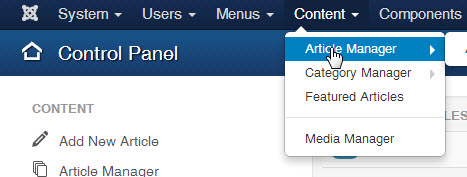
joomla3.2 article manager

2. Click on the Options button to check if Versioning is enabled and configure how many copies of articles do you want to keep.

joomla options button

3. Click on the Editing Layout tab on the Options page and check that parameters marked with a red square on the following screenshot are enabled and configured.
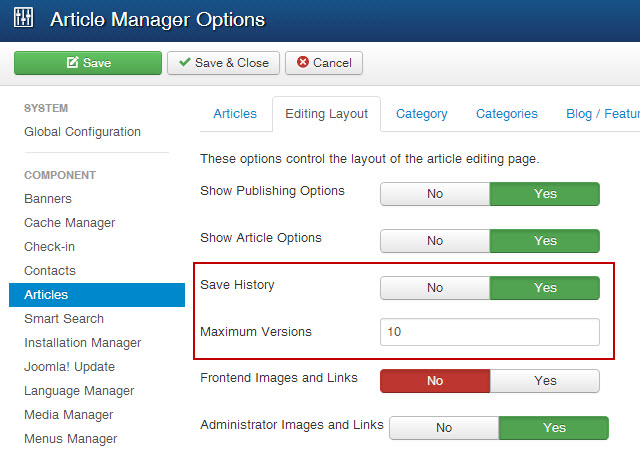
article manager options

4. Start writing new articles or edit an existing one.
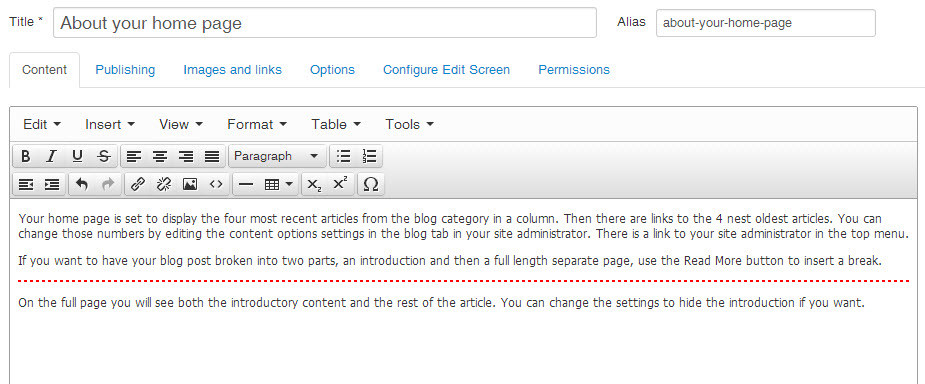
joomla article editor

5. I chose to edit an existing Joomla demo article and add some new content at the end of the article. Save your changes when you are done but don’t leave this article editing page (just click on the Save button and not on the Save & Close button).
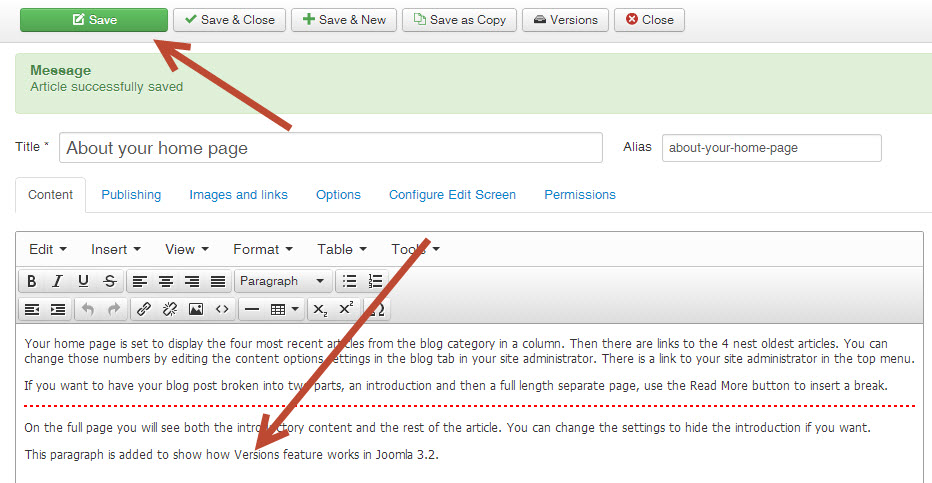
Joomla article, updated and saved

6. Click on the Versions button in the Joomla toolbar to open the Item Versions History dialog.
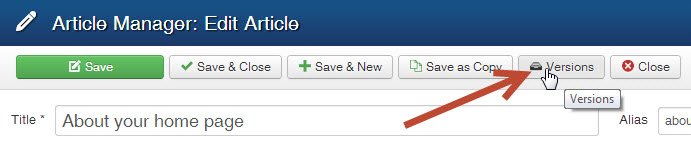
click versions button

7. You can see the Item Version History dialog on the next screenshot. Currently an active copy of the article is marked with a gold star after the information about the date and time it was saved.
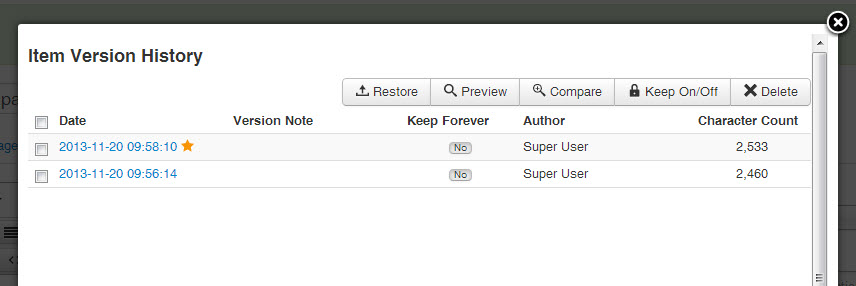
version history star marks current

8. If you select multiple history items, you can compare changes between them by clicking on the Compare button in the toolbar.
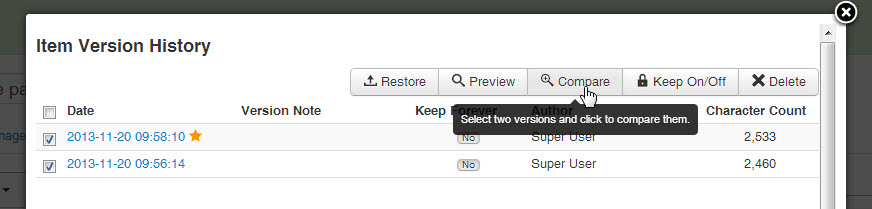
compare history versions

9. Compare view will show you changes between versions in all article fields by default. It is important to say that version keeps track not only about the changes in the article content but also about the changes in all article configurations fields also.
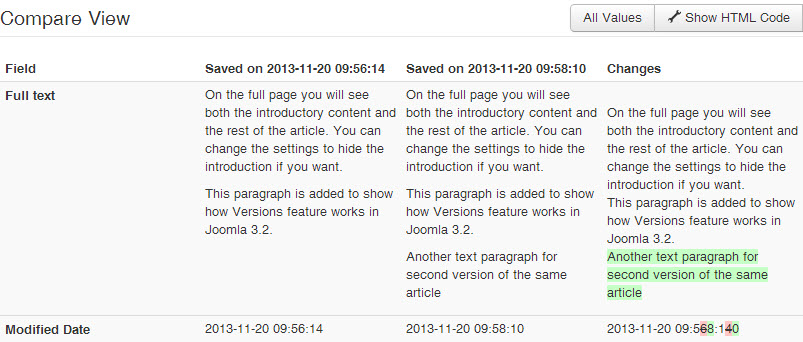
compare view of joomla articles

10. If you click on the Show HTML Code button, you can see the underlying HTML code of the articles and compare with the source level changes that happened in the article.
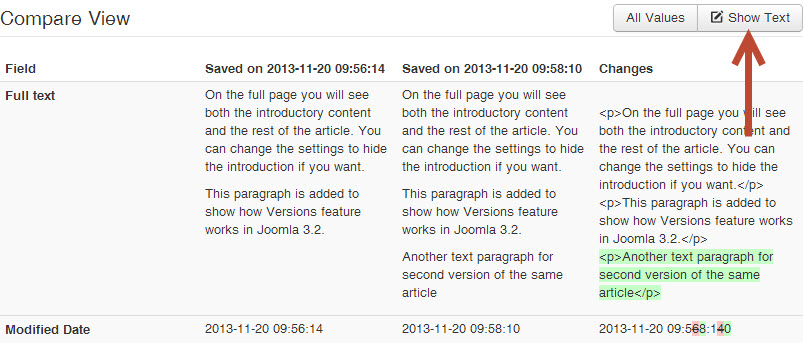
html view of articles and html changed

11. If you click on the No button (or Yes button of this is already enabled) under the Keep Forever column, you can mark history items as permanent. That means that this history item won’t be deleted in history rotation when the history item number reaches the number of items defined in the Options that we configured in the step 2 of this tutorial.
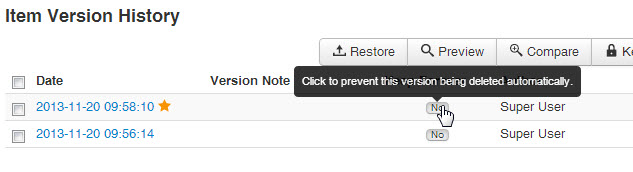
clicking to prevent version deleted

12. The first item in the item history table is marked as permanent and thus it won’t be removed from the history rotation.
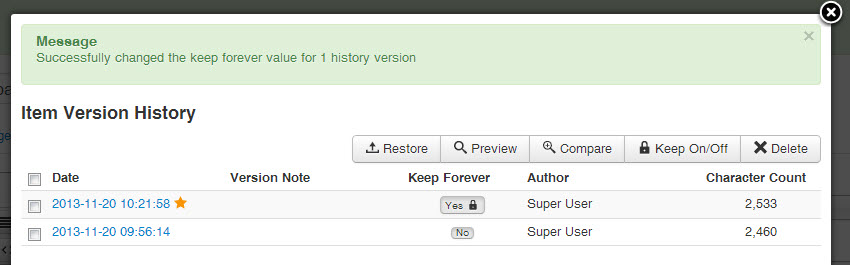
article version locked cant be deleted

13. If you decide that you want to go back in time and that you want to republish the item version you did before, just select that item in the item history list and click on the Restore button
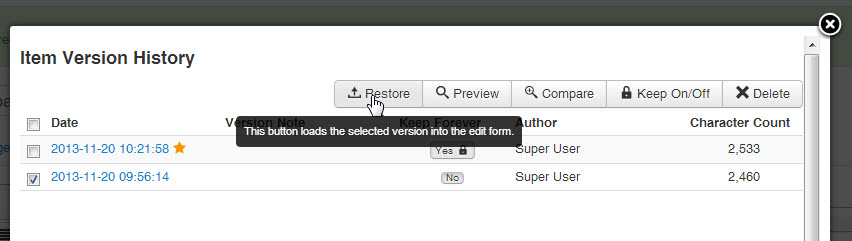
click to restore previous version

Conclusion

Over time, the goal of Joomla's developers is to unify the way that Joomla handles content whether it's in Joomla articles, user information or data from other extensions. This version control is a great start in that direction.


Joomla Hosting :: New Features of Joomla 3.2

clock December 4, 2013 07:38 by author Mike

Joomla 3.2 is an award-winning content management system (CMS), which enables you to build Web sites and powerful online applications. Many aspects, including its ease-of-use and extensibility, have made Joomla the most popular Web site software available. Best of all, Joomla is an open source solution that is freely available to everyone.

Joomla 3.2 is truly a Something New for Everyone release, which standard-term support release and is a one-click upgrade (not a migration) from previous Joomla 2.5 and 3 series releases.

Joomla 3.2 Hosting Features
Here is a list of the top new features worth checking out in Joomla 3.2:

  • Content History - Content versioning is Joomla's feature for storing, comparing, and reverting content. For example, you can use it to change back to a previous revision of an article if a mistake happens.
  • JUX Improvements -There have been dozens of improvements to the Joomla User eXperience (JUX) to provide a more user-friendly CMS. Two of my favorites are the cleaned up control panel and top menu. I especially love the way the new control panel looks.
  • Front-end Administration of Global Configuration Settings - Joomla now has two new menu item types that allow end-users to change some of the settings from the front-end. The component uses a web-services approach to change the settings.
  • TinyMCE Update - TinyMCE has been updated to 4.0 and it looks amazing. Just compare the before (above) and after (below) screenshots to decide for yourself.
  • Install from Web - The Install from Web feature will include free and commercial extensions, with commercial extensions redirecting to the developers' sites for payment, then automatic installation.
  • Joomla Multilingual-site Automatic - For those wanting a multi-lingual site, you'll now be able to set one up automatically during Joomla's initial installation saving you precious setup time.
  • Improved Template Manager - All that could be done in Template Manager was to edit pre-existing CSS files of templates, to edit root template files, and to duplicate templates.
  • Post-install Messages - There's now a post-install component that is used to notify admins of important information when Joomla or an extension is installed or updated.
  • RAD (Rapid Application Development) Layer - Joomla's new RAD layer is a rapid application development framework on top of Joomla.
  • AJAX Interface - oomla 3.2 has also added an interface for AJAX entry points. This will save development time and also provide standardization for 3rd party custom extensions.
  • Micro-data Semantics Library - Another Library that has been added for developers is one that implements http://schema.org micro-data semantics.
  • HTML5 Form Fields and Attributes - improvement for developers is the addition new HTML form fields and attributes.
  • Two Factor Authentication - TFA produces an extra temporary security code that is then sent privately to the user (e.g. to their smart phone app) and which allows them to login. This prevents unauthorized login attempts.
  • BCrypt encryption of Passwords - Joomla now provides an even stronger password encryption method using BCrypt.
  • MooTools to jQuery Conversion - Much of the Joomla Core has been converted from MooTools to jQuery, as jQuery has become the default Joomla library in Joomla 3.


Joomla Hosting :: Joomla Redirecting Multiple URLs - Home Page with .htaccess

clock October 21, 2013 08:47 by author Mike

If you've changed menu items or aliases on your website, the old links will still be indexed on Google until it gets back around to checking them again. This means that if someone is linked to your website in Google and it gives them an old link, they will get a 404 error and won't be able to view anything.

This is where redirecting comes in. We need to redirect all the old links to the new ones to ensure a viewer still gets to the correct page. This can be done individually but can take hours - this is where we can utilise a batch redirect to speed up our process. This basically enables you to take any links with a certain alias and point it to a new alias.

Here is what a default Joomla htaccess file looks like:

##
# @package		Joomla
# @copyright	Copyright (C) 2005 - 2013 Open Source Matters. All rights reserved.
# @license		GNU General Public License version 2 or later; see LICENSE.txt
##

##
# READ THIS COMPLETELY IF YOU CHOOSE TO USE THIS FILE!
#
# The line just below this section: 'Options +FollowSymLinks' may cause problems
# with some server configurations.  It is required for use of mod_rewrite, but may already
# be set by your server administrator in a way that dissallows changing it in
# your .htaccess file.  If using it causes your server to error out, comment it out (add # to
# beginning of line), reload your site in your browser and test your sef url's.  If they work,
# it has been set by your server administrator and you do not need it set here.
##

## Can be commented out if causes errors, see notes above.
Options +FollowSymLinks

## Mod_rewrite in use.

RewriteEngine On

## Begin - Rewrite rules to block out some common exploits.
# If you experience problems on your site block out the operations listed below
# This attempts to block the most common type of exploit `attempts` to Joomla!
#
# Block out any script trying to base64_encode data within the URL.
RewriteCond %{QUERY_STRING} base64_encode[^(]*\([^)]*\) [OR]
# Block out any script that includes a <script> tag in URL.
RewriteCond %{QUERY_STRING} (<|%3C)([^s]*s)+cript.*(>|%3E) [NC,OR]
# Block out any script trying to set a PHP GLOBALS variable via URL.
RewriteCond %{QUERY_STRING} GLOBALS(=|\[|\%[0-9A-Z]{0,2}) [OR]
# Block out any script trying to modify a _REQUEST variable via URL.
RewriteCond %{QUERY_STRING} _REQUEST(=|\[|\%[0-9A-Z]{0,2})
# Return 403 Forbidden header and show the content of the root homepage
RewriteRule .* index.php [F]
#
## End - Rewrite rules to block out some common exploits.

## Begin - Custom redirects
#
# If you need to redirect some pages, or set a canonical non-www to
# www redirect (or vice versa), place that code here. Ensure those
# redirects use the correct RewriteRule syntax and the [R=301,L] flags.
#
## End - Custom redirects

##
# Uncomment following line if your webserver's URL
# is not directly related to physical file paths.
# Update Your Joomla! Directory (just / for root).
##

# RewriteBase /

## Begin - Joomla! core SEF Section.
#
RewriteRule .* - [E=HTTP_AUTHORIZATION:%{HTTP:Authorization}]
#
# If the requested path and file is not /index.php and the request
# has not already been internally rewritten to the index.php script
RewriteCond %{REQUEST_URI} !^/index\.php
# and the request is for something within the component folder,
# or for the site root, or for an extensionless URL, or the
# requested URL ends with one of the listed extensions
RewriteCond %{REQUEST_URI} /component/|(/[^.]*|\.(php|html?|feed|pdf|vcf|raw))$ [NC]
# and the requested path and file doesn't directly match a physical file
RewriteCond %{REQUEST_FILENAME} !-f
# and the requested path and file doesn't directly match a physical folder
RewriteCond %{REQUEST_FILENAME} !-d
# internally rewrite the request to the index.php script
RewriteRule .* index.php [L]
#
## End - Joomla! core SEF Section.

To add our redirects, we must ensure we put them before the Joomla SEF rewrites which is generally the last part of the file. See below how you can rewrite a URL.

######PTP SEO Redirections -- BEGIN
#301 Redirect Entire Old directories
RewriteRule blog/blog-category-1(.*)$ blog/blog-category-2$1 [R,L]
######PTP SEO Redirections -- END

This basically tells anything that has blog/blog-category-1 in it to redirect to the URL blog/blog-category-2. so the url withblog/blog-category-1/sub-category/item-to-view will automatically update toblog/blog-category-2/sub-category/item-to-view

Below is where we need to add this into our htaccess file - just before the SEF rewrites.

######PTP SEO Redirections -- BEGIN
#301 Redirect Entire Old directories
RewriteRule blog/blog-category-1(.*)$ blog/blog-category-2$1 [R,L]
######PTP SEO Redirections -- END

# RewriteBase /

## Begin - Joomla! core SEF Section.
#
RewriteRule .* - [E=HTTP_AUTHORIZATION:%{HTTP:Authorization}]
#
# If the requested path and file is not /index.php and the request
# has not already been internally rewritten to the index.php script
RewriteCond %{REQUEST_URI} !^/index\.php
# and the request is for something within the component folder,
# or for the site root, or for an extensionless URL, or the
# requested URL ends with one of the listed extensions
RewriteCond %{REQUEST_URI} /component/|(/[^.]*|\.(php|html?|feed|pdf|vcf|raw))$ [NC]
# and the requested path and file doesn't directly match a physical file
RewriteCond %{REQUEST_FILENAME} !-f
# and the requested path and file doesn't directly match a physical folder
RewriteCond %{REQUEST_FILENAME} !-d
# internally rewrite the request to the index.php script
RewriteRule .* index.php [L]
#
## End - Joomla! core SEF Section.


About ASPHostPortal.com

We’re a company that works differently to most. Value is what we output and help our customers achieve, not how much money we put in the bank. It’s not because we are altruistic. It’s based on an even simpler principle. "Do good things, and good things will come to you".

Success for us is something that is continually experienced, not something that is reached. For us it is all about the experience – more than the journey. Life is a continual experience. We see the Internet as being an incredible amplifier to the experience of life for all of us. It can help humanity come together to explode in knowledge exploration and discussion. It is continual enlightenment of new ideas, experiences, and passions

 photo ahp banner aspnet-01_zps87l92lcl.png

Corporate Address (Location)

ASPHostPortal
170 W 56th Street, Suite 121
New York, NY 10019
United States

Sign in